
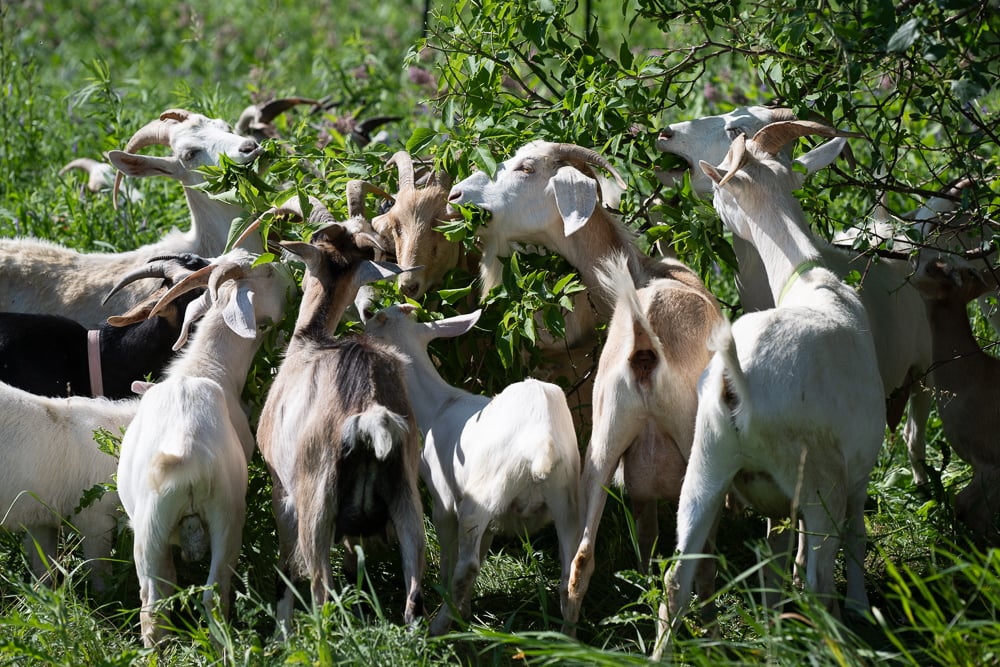
What prescribed grazing is
Prescribed grazing is the planned use of livestock to manage vegetation on a defined site, for a defined period, against a defined objective. Every variable is set in advance: which animals, how many, inside what fenced grazing area, for how long, at what time of year, and to what browse height. Nothing about it is incidental pasture use.
Goats suit the method because they browse rather than graze. They work upward through woody and broadleaf growth — the exact material that makes invasive-dominated sites hard to manage — and they work on ground that machinery cannot safely reach. Ontario's ravines, shorelines and steep park edges are full of that ground.
It is not a one-visit fix. Removing leaf area repeatedly, across seasons, is what draws down the root reserves an invasive stand relies on. A credible program is planned as a cycle with monitoring between visits, not as a single cleanup.
Where it fits — and where it doesn't
The fastest way to lose confidence in prescribed grazing is to apply it to a site it was never suited to. Screen the site first.
Strong fit
- Slopes, ravines and shoreline edges that are unsafe or impossible to mow
- Buckthorn, phragmites and dog-strangling vine stands
- Sites next to water where herbicide buffers are restrictive
- Public parks and trails where the work itself is a community-engagement opportunity
- Multi-year restoration programs with monitoring built in
Poor fit
- Manicured turf that simply needs cutting
- Sites with no way to secure temporary fencing or supply water
- One-time cleanups where the client expects a single-visit finish
- Areas with significant dumped debris or known toxic plantings until they are cleared
Building a grazing prescription
STEP 01
Define the objective
Name the outcome in land-management terms: restore a shoreline buffer, open a woodland edge, suppress phragmites ahead of planting, reduce fuel load on a slope. The objective drives every other decision.
STEP 02
Assess the site
Vegetation composition, slope, drainage, access points, water sources, public exposure, and hazards such as dumped material or toxic plants. Drone imagery helps map dense or steep areas before anyone walks them.
STEP 03
Set the grazing prescription
Herd size, fenced grazing area layout, target browse height, visit windows, and rest intervals between visits. This is the part that makes it 'prescribed' rather than incidental.
STEP 04
Plan logistics and public interface
Fencing, water, shelter, daily attendance, signage, and a communications plan for neighbouring residents and site users.
STEP 05
Graze and monitor
Fixed-point photography before, during and after each visit, plus notes on browse height and species response. Monitoring is what turns one season's work into evidence for the next.
STEP 06
Plan the follow-up season
Compare results against the objective, adjust timing or intensity, and schedule the next cycle. Most invasive-dominated sites need several seasons.
Our own process follows this shape end to end — see how we scope and run a season.
What Ontario sites have shown us
The clearest way to judge the method is to look at real sites with real constraints. Our case studies document the site condition, the grazing approach used, and what the vegetation looked like afterwards.
Don Valley Brick Works Park
Ravine slopes and heavily used public trails — municipal parkland where machinery access and public exposure both shape the prescription.
View case study →Conservation shorelines
Wet edges and phragmites stands where herbicide buffers near water narrow the options available to a land manager.
View case study →Parks and commercial grounds
Dog parks, sports parks and private grounds where the work has to run alongside continued public or member use.
View case study →Cost and procurement
There is no honest per-acre price for prescribed grazing. Cost is driven by site area, vegetation density, access, fencing and water requirements, how many visits a season needs, and how many seasons the objective requires. A steep quarter-acre buckthorn slope with no water source can cost more to service than a flat, open acre.
For budgeting, treat it as a multi-year vegetation-management line rather than a one-time service, and compare it against the full cost of the alternative — including access constraints, closures, notification requirements and repeat visits — not just the unit rate.
Public communication
On public land the herd is visible, so plan for it. Signage that explains the objective, clear fencing, attended animals, and a point of contact for residents turn what could be a complaint stream into engagement. Several of our municipal sites have drawn steady visitor interest for exactly this reason.
If you want the grazing tied to programming — school visits, interpretive sessions, community events — say so during scoping. Tell us about your event or program.
Common questions
What is prescribed grazing?
Prescribed grazing is the planned use of livestock — in our case goats — to manage vegetation on a defined site, for a defined period, to meet a defined land-management goal. Animal numbers, fenced grazing area size, timing and duration are all set in advance, and the site is monitored throughout. It is a vegetation-management method, not open pasture.
How is it different from mowing or herbicide?
Mowers need stable, accessible ground and cut everything at one height. Herbicide applications carry buffer, notification and drift constraints near water and public trails. Goats work slopes, wet edges and dense brush that machinery cannot reach, remove leaf material and seed heads through browsing, and involve no chemical application.
Which vegetation does goat browsing target?
Our Ontario work has focused on European buckthorn, phragmites, dog-strangling vine, and dense mixed brush along woodland edges and shorelines. Goats prefer woody and broadleaf growth over turf grasses, which is what makes them useful on invasive-dominated sites.
Does one season eliminate an invasive species?
No. Repeated defoliation over multiple seasons draws down the root reserves that let invasives regrow. Realistic programs are planned in multi-year cycles with monitoring between visits.
Is it safe around the public?
Sites are enclosed with temporary fencing, signage explains the work, and the herd is attended. On public sites the visibility is usually an asset: the fenced grazing area becomes an interpretive opportunity rather than a closure notice.
How is a program costed?
Cost depends on site area, vegetation density, access, water and fencing requirements, visit frequency and the number of seasons required. We scope every site individually — there is no per-acre list price. Request a site assessment and we will build the numbers against your site conditions.
More answers on our FAQ page, and details of herd welfare on Goat Care.
Next step
Find out whether your site is a fit
Send us the site details and the vegetation challenge. We'll tell you honestly whether prescribed grazing is the right method — and what a realistic program would look like.